Custom Rulers Set 3D Design Templates for Precision Crafting
In a world dominated by mass-produced stationery, there is a distinct satisfaction in holding a tool that reflects your personal taste or professional brand. The Custom Rulers Set 3D Design Templates offers more than just a way to measure length; it provides a gateway into personalized fabrication. These digital multilayer layout files are meticulously prepared for laser cutters, CNC routers, and other precision cutting machines, allowing creators to move beyond generic plastic strips and embrace unique, functional art.
Whether you are a hobbyist looking to upgrade your desk setup, a teacher aiming to engage students with tactile learning tools, or a small business owner seeking distinctive promotional items, these templates offer a versatile foundation. The ability to craft custom rulers from materials like plywood, acrylic, or even metal transforms a mundane office supply into a statement piece. This shift from consumer to creator is at the heart of the modern maker movement, and having access to high-quality, ready-to-cut files significantly lowers the barrier to entry.
Beyond Measurement: Real-World Applications
While the primary function of a ruler is to measure, the context in which it is used can vary wildly. Understanding these scenarios helps you maximize the value of the Custom Rulers Set 3D Design Templates. Here is how different users can leverage this resource:
- Educational Environments: Teachers often struggle to keep students engaged with standard geometry lessons. A ruler made from colorful acrylic or engraved wood can serve as a tangible reward or a specialized tool for classroom projects. Imagine handing out rulers with motivational quotes or subject-specific facts engraved directly onto the surface. It turns a basic supply into a keepsake that students are less likely to lose.
- Professional Branding: Architects, engineers, and designers frequently gift items to clients. A custom ruler featuring your firm’s logo, contact information, and a sleek, modern design serves as a subtle yet constant reminder of your services. Unlike a business card that gets thrown away, a high-quality wooden or metal ruler stays on the desk, visible during every sketch and calculation.
- Personalized Gifting: For the craft enthusiast in your life, a handmade ruler is a thoughtful gesture. You can customize the design to match their workshop aesthetic—perhaps using warm walnut tones for a traditional woodworker or bright, transparent acrylic for a modern scrapbooker. The double-scale feature (30 cm and 12 inches) ensures it remains practical for international users or those who work across different measurement systems.
- Art and Journaling Communities: Bullet journalers and artists appreciate tools that are both functional and beautiful. A thin, lightweight ruler made from cardboard or thin plywood can be easily carried in a sketchbook. By painting the layers before assembly, you can create vibrant, multi-colored edges that complement specific art supplies or themes.
Material Selection and Fabrication Considerations
One of the strongest advantages of using digital multilayer layout files is the flexibility in material choice. However, not all materials behave the same way under a laser or CNC bit. To achieve the best results with your Custom Rulers Set 3D Design Templates, consider the following practical observations:
Wood and MDF: Plywood and Medium-Density Fiberboard (MDF) are popular choices due to their affordability and ease of cutting. The recommended thickness for wood is between 3 mm and 6 mm (approximately 1/8 inch to 1/4 inch). When working with wood, grain direction matters. Aligning the grain along the length of the ruler increases structural integrity, reducing the risk of snapping during use. Additionally, wood absorbs finishes well, allowing you to stain or paint the ruler for a premium look. Remember to sand the edges lightly after cutting to remove any char marks from the laser.
Acrylic and Plexiglas: For a sleek, modern appearance, acrylic is unmatched. It offers transparency and durability, making it ideal for overlaying on drawings without obscuring the work beneath. When cutting acrylic, ensure your laser settings are optimized to prevent melting or excessive flaming. The finished product will have a polished edge if cut correctly, but you may need to flame-polish or buff the edges for maximum clarity. Acrylic rulers are also resistant to moisture, making them suitable for environments where wood might warp.
Metal and Cardboard: While less common for home lasers, industrial CNC routers can handle thin metal sheets, creating incredibly durable, professional-grade tools. On the other end of the spectrum, cardboard or heavy paper allows for rapid prototyping or disposable rulers for events. These materials are cost-effective and easy to cut, though they lack the longevity of wood or plastic.
Navigating the Digital Files
Upon purchasing the Custom Rulers Set 3D Design Templates, you will receive a .zip file containing a comprehensive suite of formats: .AI, .SVG, .DXF, .DWG, .CDR, .EPS, and .PDF. This variety ensures compatibility with almost any design or CAM software you might be using, from Adobe Illustrator and CorelDRAW to AutoCAD and Inkscape.
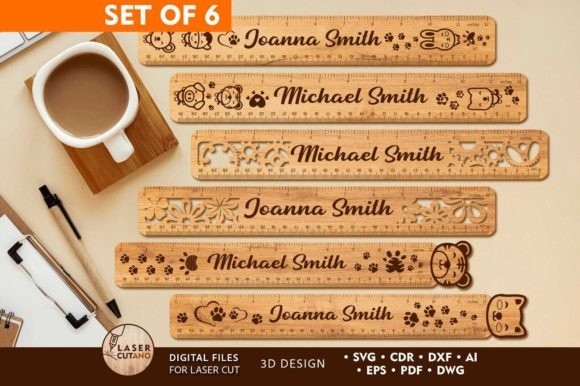
It is crucial to unzip the folder before attempting to use the files. Working directly from a compressed archive can lead to corrupted data or software errors. Once extracted, you will find that the design is structured as a single-layer multilayer layout. This means that while the final product appears three-dimensional due to the stacking of pieces, the cutting file is optimized for efficient processing. The design includes engraving vectors, which add depth and detail to the ruler’s surface, enhancing both its aesthetic appeal and readability.
The finished product dimensions are approximately 12.5 x 1.8 inches, providing a comfortable grip and sufficient surface area for clear markings. The set includes six double-scale rulers, each measuring 30 cm and 12 inches. This standard size makes them universally useful, fitting easily into pencil cases, tool belts, or desk drawers.
Assembly and Customization Tips
Creating the final ruler involves more than just cutting. The multilayer nature of the design requires careful assembly. Each layer must be glued together precisely to ensure the edges align perfectly. Misalignment can affect the accuracy of the measurements, so take your time during this step. Use clamps or weights to hold the layers in place while the adhesive dries.
A pro tip for achieving a professional finish is to paint or stain the individual layers before gluing them together. This approach prevents paint from seeping into the joints or getting on the wrong surfaces. It also allows you to create contrasting colors between the layers, highlighting the 3D aspect of the design. For example, you might paint the core layer black and the outer layers white, creating a striking visual effect that emphasizes the ruler’s depth.
While you can increase the size of the design to create larger straightedges, be cautious when reducing it. The design contains thin elements, such as measurement tick marks and engraving details. Scaling down too much can make these features fragile or difficult to cut accurately. Always test cut a small section if you plan to significantly alter the dimensions.
Why Choose Custom Over Generic?
Generic rulers are ubiquitous, but they rarely inspire joy or pride in ownership. By utilizing Custom Rulers Set 3D Design Templates, you reclaim agency over the tools you use daily. You decide the material, the finish, and the context. This level of customization fosters a deeper connection to your work, whether you are drafting a blueprint, teaching a class, or simply organizing your thoughts in a journal.
Moreover, the process of making your own tools encourages experimentation. You might discover that a certain type of wood feels better in your hand, or that a specific color combination improves visibility under your workspace lighting. These small optimizations accumulate, leading to a more efficient and enjoyable creative process. In an era where digital distractions are constant, the tactile experience of using a handcrafted tool can ground you, bringing focus and clarity to your tasks.
Ultimately, the value of these templates lies in their potential. They are not just files; they are invitations to create something meaningful. Whether you produce one ruler for yourself or a hundred for a corporate event, the result is a product that stands out in a sea of uniformity. Embrace your inner designer, explore the possibilities of different materials, and craft a tool that is truly yours.